
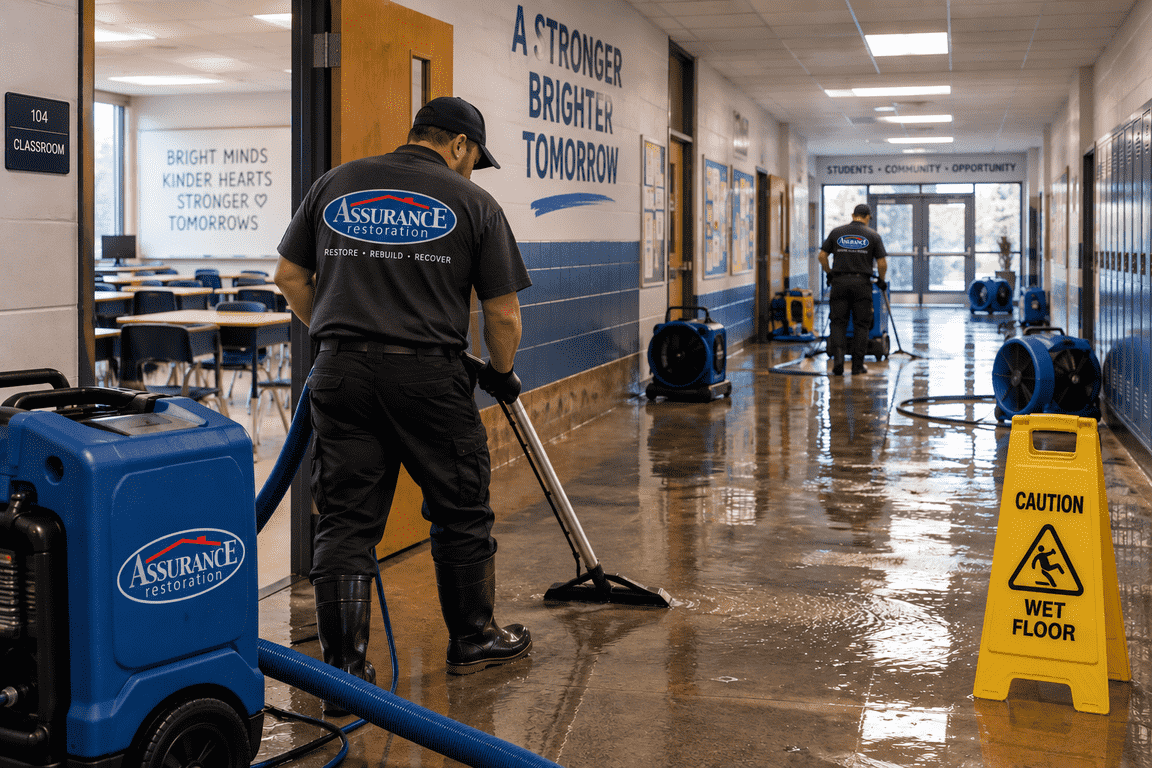
A flooded school isn't a flooded house. Water spreads through classrooms, hallways, offices, libraries, cafeterias, and mechanical rooms long before anyone finds the full extent of it. Administrators aren't just dealing with wet floors — they're dealing with students, staff, equipment, records, and a timeline for getting the building back in use.
Burst pipe. Roof leak. Storm. Plumbing failure. Broken equipment. The cause doesn't matter as much as the first few hours.
Assurance Restoration handles professional school water damage restoration in Tulsa and surrounding areas — removing water, drying affected materials, tracking down hidden moisture, and repairing what's damaged. Knowing how the process works helps administrators make faster, better calls when the water starts.
What Should a School Do Immediately After a Flood?
Protect people first. Keep students and staff out of any area with standing water, exposed electrical systems, ceiling damage, or water that might be contaminated.
Stop the source if it's safe to do so — shut off a plumbing line, address a failed fixture, or seal off a storm-damaged section of the building.
From there, a professional water damage restoration team maps out how far the water actually traveled.
That initial response usually includes:
- Identifying the source and category of water
- Extracting standing water
- Mapping moisture throughout affected areas
- Moving or protecting furniture and equipment
- Removing materials that can't be restored
- Setting up professional drying and dehumidification equipment
Drying the floor isn't the job. Finding out where the water went — and stopping it from causing more damage — is the job.
Why Emergency Water Removal Matters in Schools
Schools are full of materials that soak up water fast. Drywall, ceiling tiles, carpet, insulation, wood, upholstered furniture — all of it holds moisture long after the flooding looks gone.
Water also gets under flooring and into wall cavities where you can't see it.
That's why real emergency water removal in Tulsa relies on moisture meters and detection equipment, not just extraction gear. Technicians need to know what's wet, how deep the moisture goes, and whether it can actually be dried out or not.
Our guide on hidden water damage breaks down why the moisture you can't see is the moisture that keeps causing problems.
How Does Flooded School Cleanup Work?
Once the standing water's gone, drying starts.
Air movers and dehumidifiers go up throughout the affected areas to pull moisture out of building materials and get humidity under control. The team tracks conditions as they go — nobody just runs equipment for a set number of days and hopes for the best.
A large school might need separate drying zones. One wing has minor intrusion; another needs flooring, drywall, or insulation pulled out entirely. Zoning the work means every part of the building gets treated based on what actually happened there, not a blanket approach.
Where it makes sense, professional carpet and upholstery cleaning saves materials that would otherwise get tossed and replaced.
What If the Flood Water Is Contaminated?
Not every school flood is clean water.
Sewer backups, overflowing drains, certain types of floodwater — these bring contaminants into the building, and they don't get treated like a normal plumbing leak.
Affected areas may need containment, removal of porous materials, cleaning, and sanitization before any reconstruction starts. Sewage cleanup matters most when wastewater hits classrooms, restrooms, or cafeterias — spaces students and staff use every day.
The source and category of water determines everything downstream: what gets cleaned, what gets dried, what gets removed.
Can a School Stay Open During Water Damage Restoration?
Depends on where the damage is and how bad it is.
A small leak in one section of the building might not disrupt anything else. A major flood hitting electrical systems, multiple classrooms, or core building systems is a different story — that takes real coordination.
Restoration professionals can tell administrators exactly which areas are affected and what has to happen before those spaces reopen.
Speed matters here. But rushing repairs before the moisture is actually gone just means dealing with the same problem twice.
What Happens If the School Needs Major Repairs?
Sometimes drying and cleaning isn't enough.
Drywall needs replacing. Flooring needs to come out and go back in. Cabinets, trim, insulation, ceilings, structural materials — any of it can need repair.
Assurance Restoration handles reconstruction and rebuilding services after major property damage. Running restoration and reconstruction through the same company cuts the delay between emergency mitigation and permanent repair.
For schools working toward reopening classrooms — or trying to finish repairs over a weekend or scheduled break — that coordination is the difference between on-time and behind schedule.
Preparing Tulsa Schools Before the Next Water Emergency
Think about the flood before it happens, not during it.
Administrators and facility managers should know exactly where the major water shutoffs are, keep emergency contacts on hand, and inspect the usual trouble spots regularly.
That's roofs, mechanical rooms, restrooms, kitchens, water heaters, supply lines, drainage systems.
Have a plan for isolating affected areas and protecting equipment, records, and materials — one that can be executed fast and safely.
A little prep turns the first few hours of an emergency from chaos into a checklist.
School Water Damage Restoration in Tulsa and Surrounding Areas
Removing the visible water is step one. Real restoration means finding hidden moisture, drying the structure, handling contaminated materials when they're present, and finishing repairs so the space is usable again.
Assurance Restoration provides commercial water damage restoration in Tulsa and surrounding communities — water extraction, structural drying, cleaning, storm damage restoration, and reconstruction.
If your school just dealt with flooding, a burst pipe, a roof leak, or any other water emergency, contact Assurance Restoration and get a plan for what happens next.