A single unit flood is a maintenance call. A building-wide flood is a crisis.
When water enters an apartment complex — whether from a burst pipe, a failed water heater on an upper floor, a sewage backup, or an Oklahoma storm — the scale of the problem multiplies fast. Multiple units affected. Displaced tenants. Insurance documentation. Ongoing liability. And a restoration timeline that directly impacts occupancy and revenue.
Property managers in Tulsa who’ve been through it know the first few hours are what determine how expensive and how disruptive the recovery becomes. This guide covers what actually happens when an apartment complex floods — and what experienced property managers do differently.
Why Multifamily Water Damage Is More Complex Than a Single-Family Loss
Apartment building floods don’t behave like residential water damage. Water from a broken supply line on the third floor doesn’t stay on the third floor. It moves down through ceiling assemblies, into wall cavities between units, beneath flooring on every level it reaches. By the time it’s visible in a ground floor unit, it may have traveled through three floors of building materials that all need to be assessed.
The complexity compounds from there:
- Multiple tenants are affected simultaneously, each with their own belongings and displacement concerns
- Common areas, hallways, laundry rooms, and mechanical spaces may all be involved
- Mold risk escalates quickly in multifamily construction because moisture has more pathways and more places to hide
- Documentation requirements for insurance are more extensive than a typical residential claim
- Every hour the property isn’t fully restored is an hour of potential revenue loss and tenant relations pressure
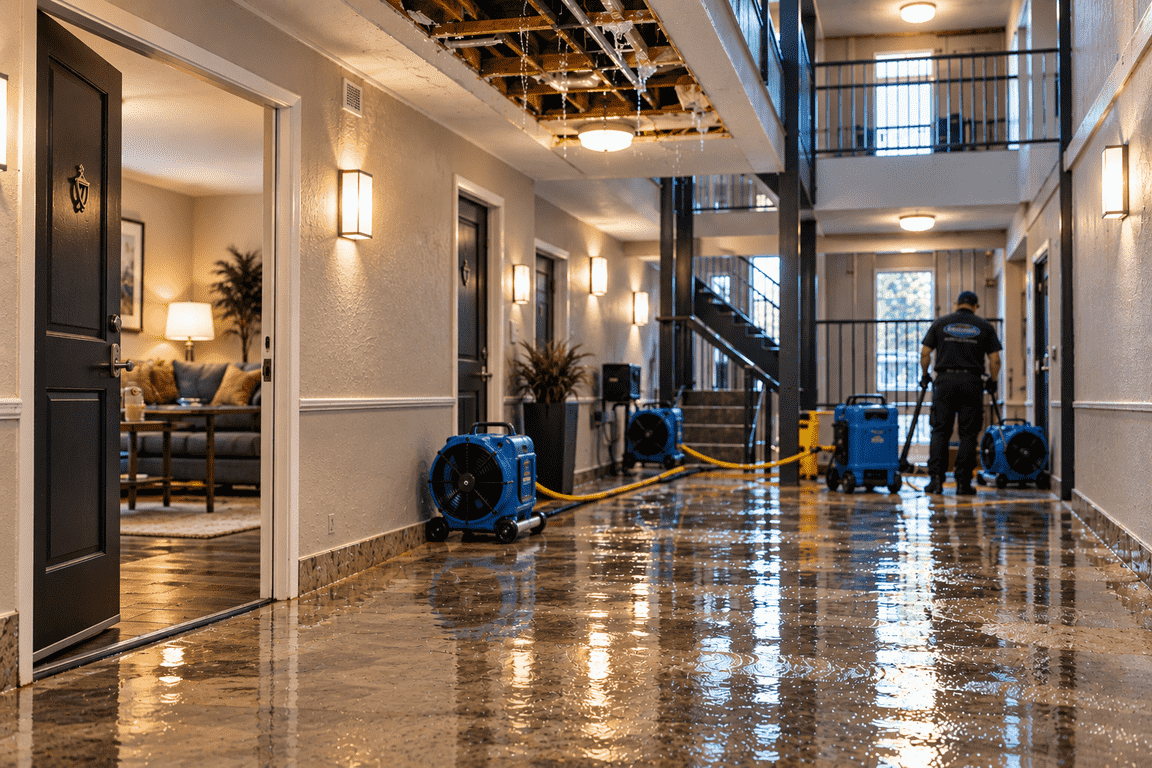
Commercial water damage restoration for apartment buildings requires a different scale of response — more equipment, more technicians, more simultaneous drying zones, and a restoration plan coordinated around an occupied building.
The First 24 Hours — What Has to Happen
Speed is the variable that controls everything else. Here’s what experienced property managers prioritize immediately:
Stop the source. Identify and shut off the water supply. For plumbing failures, that’s the unit shutoff or the building main. For roof intrusion during a storm, that means emergency tarping as soon as conditions allow.
Protect tenants. Assess which units are safe to occupy and which need to be vacated. Residents with mobility limitations, medical equipment, or units with structural concerns get priority attention. Document the condition of every affected unit before cleanup begins.
Document everything. Photograph and video every affected area before extraction starts. This documentation supports insurance claims and protects the property management company from disputes later.
Call a restoration company immediately. Hidden moisture in multifamily buildings is the most expensive problem in apartment water damage — not what’s visible, but what’s soaking into shared walls, subfloor assemblies, and ceiling systems between units. The faster professional extraction and moisture mapping begin, the less material requires replacement.
What Professional Apartment Water Restoration Actually Involves
Commercial water restoration at the apartment building scale is a coordinated operation, not a series of individual unit repairs.
Restoration technicians perform moisture mapping across the entire affected area — not just the units with visible water. Thermal imaging identifies saturation in wall assemblies and ceiling systems that visual inspection misses entirely. Commercial extraction equipment, industrial air movers, and high-capacity dehumidifiers get positioned throughout affected floors and common areas simultaneously.
Drying happens based on moisture meter readings — not on how things look or feel. A hallway carpet that appears dry can be sitting on saturated subfloor. Drywall that feels solid can have wet insulation behind it. Mold can establish itself within 48 hours in the conditions a multifamily building creates after a water event — shared walls, limited airflow between units, and building materials that hold moisture longer than residential construction typically does.
When sewage is involved, the situation requires a different response entirely. Sewage cleanup in an occupied building means immediate containment, restricted access to affected areas, and removal of contaminated porous materials — drywall, flooring, insulation — rather than standard drying procedures.
Reconstruction After an Apartment Building Flood
Once extraction and drying are complete and moisture levels are verified throughout the affected areas, the rebuild begins.
For apartment buildings, reconstruction often involves multiple units simultaneously — drywall replacement, flooring installation, painting, cabinetry repair, and restoration of common areas all running in parallel. Reconstruction services coordinated by the same team that handled mitigation move faster and with fewer gaps than projects handed off between separate contractors.
Property managers who work with a single restoration company through both phases — mitigation and rebuild — consistently report shorter overall timelines, cleaner insurance documentation, and fewer disputes about what was found during the project.
What Tulsa Property Managers Get Wrong After a Building Flood
A few patterns consistently make apartment building water losses more expensive than they need to be:
Waiting to call a restoration company. Every hour of delay is more moisture absorbed into more building materials. What costs extraction and drying today costs demolition and replacement tomorrow.
Treating it as individual unit repairs. Apartment building water damage has to be assessed and addressed as a building system — not a collection of separate residential claims. The moisture doesn’t respect unit boundaries and neither should the restoration plan.
Relying on appearance to determine when drying is complete. Surfaces dry faster than structural materials. Professional moisture verification is what confirms the building is actually dry — not how it looks or feels.
Underestimating mold timeline. Forty-eight hours is enough. If moisture mapping isn’t completed quickly and drying doesn’t start fast, mold remediation becomes part of the project whether it was planned for or not.
One Team From Emergency Response to Move-Back-In Ready
Apartment complex flooding is one of the most operationally demanding property damage scenarios a Tulsa property manager will face. The variables — tenant displacement, building-wide moisture, insurance coordination, reconstruction across multiple units — all move faster than a single-family loss and carry higher stakes at every step.
Having one experienced team manage the full scope — extraction, drying, documentation, reconstruction, and tenant communication support — is what keeps the timeline compressed and the outcome predictable.
Contact Assurance Restoration to discuss your property or request emergency response for an active water event. Tulsa and surrounding areas — commercial properties, multifamily buildings, and apartment complexes included.